
The Optimal Time and Conditions for Vitamin B12 (Cobalamin) Supplementation
The Optimal Time and Conditions for Vitamin B12 (Cobalamin) Supplementation
1. The Best Time of Day to Take Vitamin B12 (Morning vs. Night)
Determining the optimal time of day to take a vitamin B12 (cobalamin) supplement requires understanding its direct effects on cellular energy production and its complex interactions with the body’s circadian rhythm (biological clock).
Cellular Energy Production and ATP Synthesis
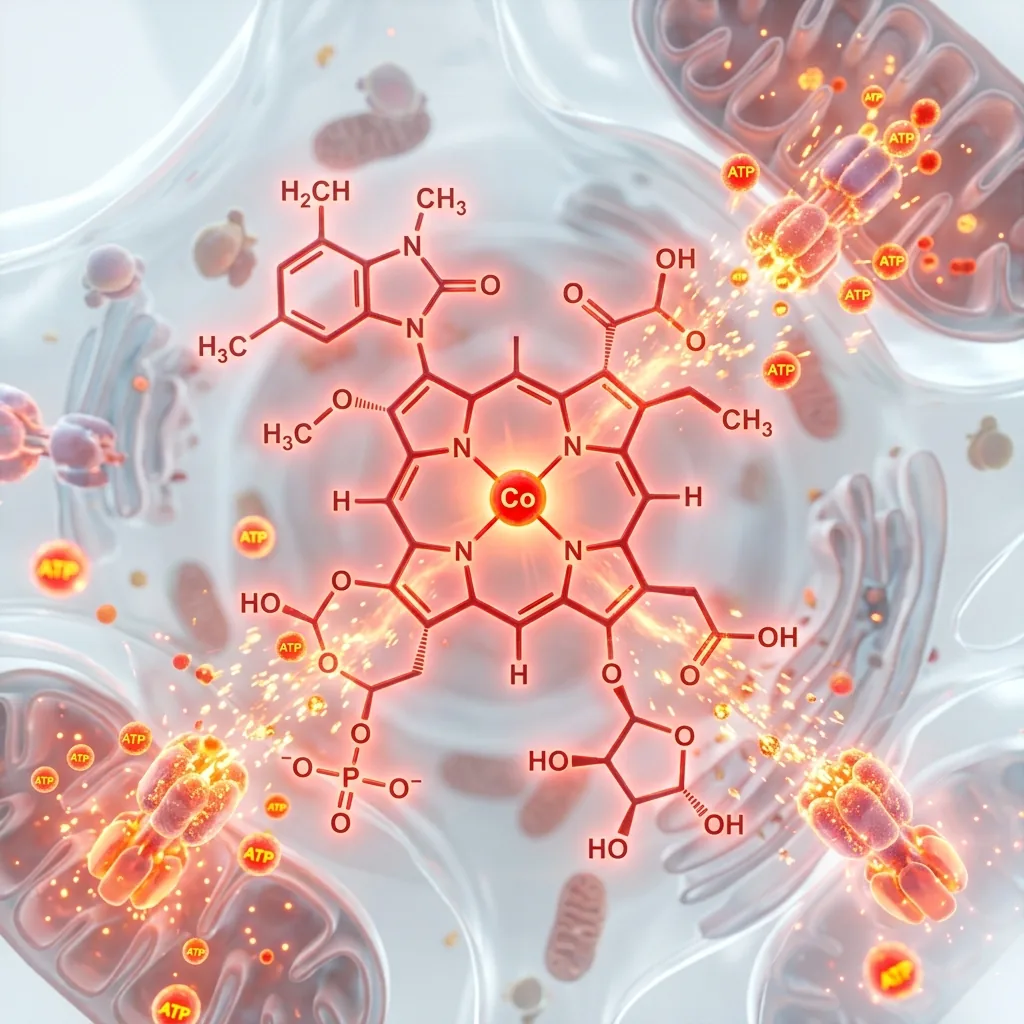
At a biochemical level, while vitamin B12 is not a direct source of energy, it serves as an indispensable cofactor (coenzyme) in vital metabolic processes carried out in the mitochondria—the energy powerhouses of the cell. There are only two fundamental enzymes in the human body that depend on vitamin B12:
- L-Methylmalonyl-CoA Mutase (MUT): Located in the mitochondria, this enzyme enables the breakdown products of certain fatty acids and amino acids to enter the Krebs (citric acid) cycle, the primary energy cycle of cells. The enzyme converts L-methylmalonyl-CoA to succinyl-CoA. Succinyl-CoA is a crucial fuel that directly feeds the synthesis of adenosine triphosphate (ATP), the cellular energy currency. In B12 deficiency, this conversion is interrupted; methylmalonic acid (MMA) accumulates, mitochondrial energy efficiency drops, and muscle mass loss (particularly in the soleus and gastrocnemius muscles) may occur.
- Methionine Synthase (MTR): Located in the cell cytoplasm, this enzyme converts homocysteine—an amino acid whose high levels damage vascular health—into methionine. This process is essential for cell division, protein production, and the synthesis of neurotransmitters (dopamine and serotonin) that govern focus and motivation in the brain.
Research at the cellular level shows that physiological doses of B12 support cell survival, rapidly activate antioxidant defense mechanisms, and protect cells against oxidative damage, thereby restoring energy balance. In individuals suffering from B12 deficiency, reactivating these biochemical pathways through supplementation is often perceived as a sudden “energy boost” or revitalization.
Melatonin Production, the Biological Clock, and Sleep Disorders
The stimulatory and revitalizing effects of vitamin B12 on the nervous system also have a pronounced impact on the circadian rhythm and the release of melatonin (the sleep hormone). Melatonin is secreted by the pineal gland in the brain, signaling the body to shift into “night mode.”
Clinical studies have revealed that vitamin B12 supplementation directly influences the circadian rhythm. In a controlled clinical trial involving healthy individuals, it was found that both cyanocobalamin and methylcobalamin forms significantly reduced the urinary excretion of melatonin breakdown products (6-sulfatoxymelatonin), particularly between 07:00 and 11:00 in the morning. The same study observed that both forms of B12 increased physical activity levels during the night (23:00-07:00), and the methylcobalamin form, in particular, shortened total sleep duration. Methylcobalamin was found to exert a psychotropic effect in the brain that enhances wakefulness.
Conversely, B12 deficiency can also disrupt sleep patterns. For instance, research on patients with obstructive sleep apnea (OSA) has found that low B12 levels (below 380.5 pg/mL) prolong sleep latency (the time it takes to fall asleep) and disrupt REM/NREM sleep stages. Similarly, in another study with 512 participants, B12 levels below 342 pg/mL were directly associated with insomnia symptoms, particularly in the elderly and women. However, aside from synchronizing the circadian rhythm or treating a deficiency, taking high doses of B12 in the evening or at night can delay or suppress melatonin release, leading to difficulty falling asleep, restlessness, and insomnia in sensitive individuals.
Why Morning Intake is Recommended
Clinical authorities recommend taking vitamin B12 supplements in the morning on an empty stomach. A morning dosage aligns the mental clarity, wakefulness, and cellular energy support provided by the supplement with the most active hours of the day. This approach supports the circadian rhythm while preventing potential risks of nighttime insomnia.
[!TIP] Simplify Your Vitamin Tracking Remembering to take your B12 supplement regularly in the morning can be challenging. By using the SuppTime app, you can set custom reminders for your morning routine and ensure your B12 levels remain optimal!
2. Stomach Fullness (Empty Stomach or After a Meal?)
The absorption of vitamin B12 by the body is one of the most complex, multi-stage digestive processes in human physiology. This absorption mechanism directly dictates whether the supplement should be taken on an empty or full stomach.
The Role of Stomach Acid and Intrinsic Factor in Absorption
For natural vitamin B12 obtained from food to be absorbed, the following biochemical stages—spanning from the stomach to the end of the small intestine—must be successfully completed:
- Release in the Stomach: Dietary proteins bound to B12 must be broken down by hydrochloric acid and the pepsin enzyme in the stomach, liberating the B12 from the protein.
- Binding to Haptocorrin: To protect it from the destructive effects of stomach acid, the free B12 binds to a protective protein called haptocorrin (R-protein), secreted by the salivary glands and gastric mucosa.
- Binding to Intrinsic Factor (IF): As this complex passes into the duodenum, pancreatic enzymes digest the haptocorrin. The newly freed B12 then binds to “intrinsic factor” (IF), a highly specialized protein produced by parietal cells in the stomach that exhibits a high affinity for B12 in this non-acidic, alkaline environment.
- Receptor-Mediated Absorption: The B12-IF complex reaches the terminal ileum, the final section of the small intestine. Here, it binds to cubam (cubilin and amnionless) receptors—which operate dependent on calcium ions (Ca²⁺)—located on the surface of intestinal cells and is absorbed into the cell via endocytosis.
Absorption Dynamics of B12 Supplements
| Parameter / Condition | Natural B12 from Food | Crystalline B12 from Supplements |
|---|---|---|
| Protein Binding | Tightly bound to food proteins. | Free (crystalline) form. |
| Stomach Acid Requirement | Requires high stomach acid and pepsin to detach from protein. | Does not require stomach acid to detach. |
| Intrinsic Factor (IF) Requirement | Absolutely dependent on IF for active absorption. | Dependent on IF at low doses; absorbed via passive diffusion at high doses. |
| Absorption Site | Absorbed exclusively from the terminal ileum. | Absorbed from both the terminal ileum (active) and throughout the entire intestine (passive). |
Unlike regular foods, the vitamin B12 found in supplements is in a free (crystalline) form. Consequently, supplement absorption completely bypasses the need for stomach acid to break down proteins. Since vitamin B12 is a water-soluble vitamin, it does not require dietary fats or bile secretions for absorption.
Clinically, it is recommended to take B12 supplements in the morning on an empty stomach, at least 30 minutes before eating, or 2 hours after a meal, with just water. This method allows the free B12 molecules to bind directly to intrinsic factor and reach the receptors in the terminal ileum at maximum rates, without competing with dietary fibers, other minerals, or digestive residue.
However, in some individuals with sensitive digestive systems, taking B vitamins on an empty stomach may cause mild nausea or cramping. In such cases, taking the supplement with a light meal improves compliance, albeit with a slight compromise in the absorption rate. Furthermore, when taking high-dose supplements (500–1000 mcg), the limited capacity of the intrinsic factor system (which saturates at approximately 1.5–2.5 mcg per dose) is exceeded, and roughly 1% of the B12 is absorbed across the intestinal wall via “passive diffusion”—requiring no transport proteins at all.
3. Food and Drug Interactions
The bioavailability of vitamin B12 can be significantly hindered by certain popular beverages, dietary supplements, and widely prescribed medications.
Coffee and Caffeine
Epidemiological research examining the relationship between diet and micronutrient absorption indicates that habitual heavy coffee consumption (3 or more cups a day) can negatively affect B12 and folate levels in blood serum. Chlorogenic acid and other polyphenols in coffee can disrupt homocysteine metabolism, thereby increasing the body’s demand for B12 and indirectly hindering absorption processes.
Although older literature suggested that acute coffee intake temporarily stimulates stomach acid and intrinsic factor secretion, modern findings strongly advise against consuming caffeine concurrently with B12 supplements. Cellular models have shown that to repair mitochondrial stress and cellular damage caused by caffeine, the body rapidly depletes its B12 stores. Therefore, you should wait at least 30 to 60 minutes after taking a morning B12 supplement before drinking coffee.
Vitamin C (Ascorbic Acid)
Taking high doses of vitamin C (ascorbic acid) supplements simultaneously with vitamin B12 can chemically degrade B12’s structure. In vitro and kinetic studies demonstrate that in aqueous solutions, ascorbic acid reduces the trivalent cobalt ion (Co³⁺) at the center of B12 to a divalent active form (Co²⁺), resulting in the irreversible destruction of the corrin ring. This chemical degradation reaction reaches its peak velocity around a pH of 5.0.
Historically, it was shown that B12 in food is protected from this destructive effect of vitamin C due to protein bonds, and consuming 1 gram of vitamin C does not severely impair natural absorption in the human body. However, to completely eliminate risks when supplementing, there is a clear clinical precaution: To fully preserve the biological activity of vitamin B12, vitamin C supplements should be taken at least two hours after B12 intake.
Proton Pump Inhibitors (PPIs) and H2 Blockers
Proton pump inhibitors (lansoprazole, omeprazole, pantoprazole, etc.) and H2 receptor blockers—commonly known as stomach protectors or acid reflux medications—almost entirely halt the stomach’s acid production. The lack of an acidic environment blocks the passive protein digestion in the stomach, preventing the release of food-bound B12.
Long-term use (6 months or more) of PPIs clinically increases the risk of B12 deficiency significantly. However, because these drugs do not directly destroy the function of the intrinsic factor secreted by the stomach, they do not inhibit the active absorption of free (crystalline) B12 supplements. Consequently, individuals using chronic stomach acid-suppressing medications must turn to dietary supplements to meet their B12 needs.
Metformin
Metformin, the first-line agent in diabetes treatment, leads to B12 deficiency over time in 10% to 30% of patients. Metformin alters the electrical charge of cell membranes in the terminal ileum—the final part of the small intestine—acting essentially as a calcium channel blocker.
Because the binding of the B12-IF complex to the cubam receptor is strictly dependent on calcium ions (Ca²⁺), metformin physically obstructs this binding and blocks active absorption. Clinical trials have proven that this absorption barrier can be overcome by taking a daily supplement of 1.2 grams of calcium carbonate, which successfully normalizes active B12 (holotranscobalamin) levels.
Micronutrient and Drug Interaction Matrix
| Interacting Substance | Affected B12 Form / Process | Clinical Effect and Mechanism | Prevention Strategy |
|---|---|---|---|
| Vitamin C (Ascorbic Acid) | All B12 forms (especially the more sensitive hydroxocobalamin). | Reduces the cobalt atom, causing irreversible breakdown of the corrin ring. | Leave at least a 2-hour gap between taking both supplements. |
| Metformin | Active B12-Intrinsic Factor absorption process. | Blocks calcium-dependent receptor binding in the ileum. | Consider calcium supplementation alongside B12. |
| Proton Pump Inhibitors | Only natural, protein-bound B12 found in foods. | Reduces stomach acid and pepsin, preventing B12 from detaching from food. | Use free crystalline supplements that do not require acid for absorption. |
| Coffee and Caffeine | Overall blood levels of B12 and folate. | Can lead to an increase in homocysteine via chlorogenic acid metabolism. | Take the supplement in the morning on an empty stomach with water; delay coffee consumption. |
| Reducing Sugars (Dextrose/Sucrose) | Liquid or chewable cyanocobalamin supplements. | Degrades B12 over time within the supplement formula due to chemical incompatibility. | Avoid dextrose or sucrose-based sugary B12 syrups. |
4. Differences Between Supplement Forms
Vitamin B12 supplements sold in pharmacies are primarily offered in two main chemical forms: Synthetic cyanocobalamin and a natural form, methylcobalamin.
Cyanocobalamin
Cyanocobalamin is a synthetic cobalamin form that does not occur naturally and is produced industrially via bacterial fermentation. In this form, a stable cyanide molecule is attached to the central cobalt atom. Because it contains only a microscopic amount of cyanide, it does not cause toxic harm to the body; however, it is harder to metabolize for individuals who already have a high cyanide load, such as smokers.
Cyanocobalamin is highly stable against heat, light, and acid changes; therefore, it is the most frequently preferred, long-shelf-life form in dietary supplements and multivitamins. Once it enters the body and reaches the inside of a cell, the cyanide group is removed (decyanation) by an intracellular protective protein called MMACHC, converting it into a cob(II)alamin intermediate. The cell then converts this intermediate into active methylcobalamin or adenosylcobalamin forms according to its specific needs.
Methylcobalamin
Methylcobalamin is a bioidentical form of B12 that naturally exists directly in foods and is fully compatible with human physiology. It has a methyl group attached to its central cobalt atom. Chemically, it is much more sensitive than cyanocobalamin and rapidly degrades into hydroxocobalamin, especially when exposed to light.
Although marketed by manufacturers as the “directly usable active form,” scientific realities do not fully support this claim. When methylcobalamin is taken externally as a supplement, once it enters the cell, the MMACHC protein strips off its methyl group (dealkylation), reducing it to a standard cobalamin molecule. The cell then synthesizes new methylcobalamin from this raw material using its own internal mechanisms. Therefore, in a healthy body, using a methylcobalamin supplement does not offer metabolic superiority or cellular processing ease over cyanocobalamin.
Differences in Absorption and Tissue Retention
The fundamental difference between the two forms emerges after they enter the body, regarding their absorption rates, urinary excretion speeds, and amounts stored in tissues:
- Nasal and Sublingual Absorption: Methylcobalamin holds a distinct advantage over cyanocobalamin, particularly in absorption through the nasal mucosa. Measurements have shown that the bioavailability of nasal spray methylcobalamin is approximately 20%, whereas for cyanocobalamin, this rate is limited to 2% to 6%.
- First Oral Absorption Rate: At very low oral doses (such as 1 mcg), the percentage of cyanocobalamin absorbed by the intestines (49%) is slightly higher than that of methylcobalamin (44%).
- Renal Excretion Speed: Because cyanocobalamin is a foreign compound to the body, it is rapidly filtered by the kidneys. Clinical studies have demonstrated that cyanocobalamin is excreted in urine roughly 3 times faster and in much higher proportions compared to methylcobalamin.
- Tissue Retention and Liver Storage: Because methylcobalamin is not rapidly lost in urine, it is retained in tissues for much longer. Animal and human analyses have proven that methylcobalamin supplementation results in 13% more B12 being stored in the liver compared to cyanocobalamin.
- Clinical Serum Levels (Active B12): Interestingly, a controlled study on strict vegans in Romania found that individuals using long-term cyanocobalamin supplementation had significantly higher and more stable active transport B12 (holotranscobalamin / holoTC) levels compared to those using methylcobalamin (150 pg/L vs. 78.5 pg/L). This phenomenon stems from cyanocobalamin’s rapid blood distribution capability.
Summary Comparison: Cyanocobalamin vs. Methylcobalamin
| Comparison Criteria | Cyanocobalamin Supplement | Methylcobalamin Supplement |
|---|---|---|
| Origin and Source | Synthetic; lab-produced. | Natural; bioidentical food form. |
| Moleküler Stability | Highly resistant to heat, light, and acid. | Extremely sensitive to light; degrades quickly. |
| Renal Filtration Rate | High; 50% to 98% of the taken dose is rapidly excreted in urine. | Low; circulates in the body for a longer period. |
| Liver Storage | Lower. | Provides 13% higher storage in liver tissue. |
| Sublingual / Nasal Transfer | Low (2-6% nasal absorption). | High (~20% nasal bioavailability). |
| Cellular Processing Load | Cyanide must be detached by the MMACHC enzyme. | The methyl group must be detached by the MMACHC enzyme. |
| Target Audience / Preference Reason | Those seeking cost-effective daily protection and stable shelf life. | Those desiring long-term high tissue storage and less urinary loss. |
References
- Mayer G, Kröger M, Meier-Ewert K. Effects of vitamin B12 on performance and circadian rhythm in normal subjects. Neuropsychopharmacology. 1996.
- Bauman WA, et al. Increased intake of calcium reverses vitamin B12 malabsorption induced by metformin. Diabetes Care. 2000.
- Termanini B, et al. Effect of long-term gastric acid suppressive therapy on serum vitamin B12 levels in patients with Zollinger-Ellison syndrome. Am J Med. 1998.
- Kozyraki R, Cases O. Vitamin B12 absorption: mammalian physiology and acquired and inherited disorders. Biochimie. 2013.
- Bouloukaki I, et al. Association of Vitamin B12 Status with Polysomnographic Parameters and Cardiovascular Disease in Patients with Obstructive Sleep Apnoea. Nutrients. 2025.
This article is for informational purposes only and does not constitute medical advice. Consult a qualified healthcare professional before changing your supplement or medication routine.
Common Questions
Is it better to take B12 in the morning or at night?
Morning, on an empty stomach. B12 supports cellular energy production and can suppress melatonin release, so taking it before bed may cause difficulty falling asleep in sensitive individuals.
Should B12 be taken with food or on an empty stomach?
On an empty stomach with just water, ideally 30 minutes before eating or 2 hours after a meal. Supplemental B12 is already in a free (crystalline) form and doesn't need stomach acid to be absorbed, unlike food-bound B12.
What's the difference between cyanocobalamin and methylcobalamin?
Cyanocobalamin is synthetic and highly stable with a long shelf life, while methylcobalamin is the bioidentical form found in food and is retained longer in tissue but degrades faster when exposed to light. Once inside a cell, both are converted to the same active forms.
Can coffee or vitamin C interfere with B12 absorption?
Yes. High-dose vitamin C can chemically degrade B12's structure, and habitual heavy coffee intake is associated with lower serum B12 levels. Separate B12 from vitamin C by at least 2 hours and from coffee by 30-60 minutes.