
Vitamin K2 Supplement Guide: MK-4 vs. MK-7, Absorption, and the Warfarin Interaction
Vitamin K2 has one of the strangest reputations in supplementation: it’s simultaneously described as essential, poorly understood, and — for a specific group of people — genuinely dangerous. All three descriptions are accurate, and the reason comes down to a single mechanism that most vitamin D and calcium supplement labels never mention.
Vitamin K2 (menaquinone) is a cofactor, not a standalone nutrient in the way vitamin C or zinc are. It doesn’t do much on its own; it activates other proteins that do the actual work. That distinction explains why K2 deficiency doesn’t look like scurvy or anemia — it looks like calcium ending up in the wrong place.
Two Vitamins Named “K”: Phylloquinone vs. Menaquinone
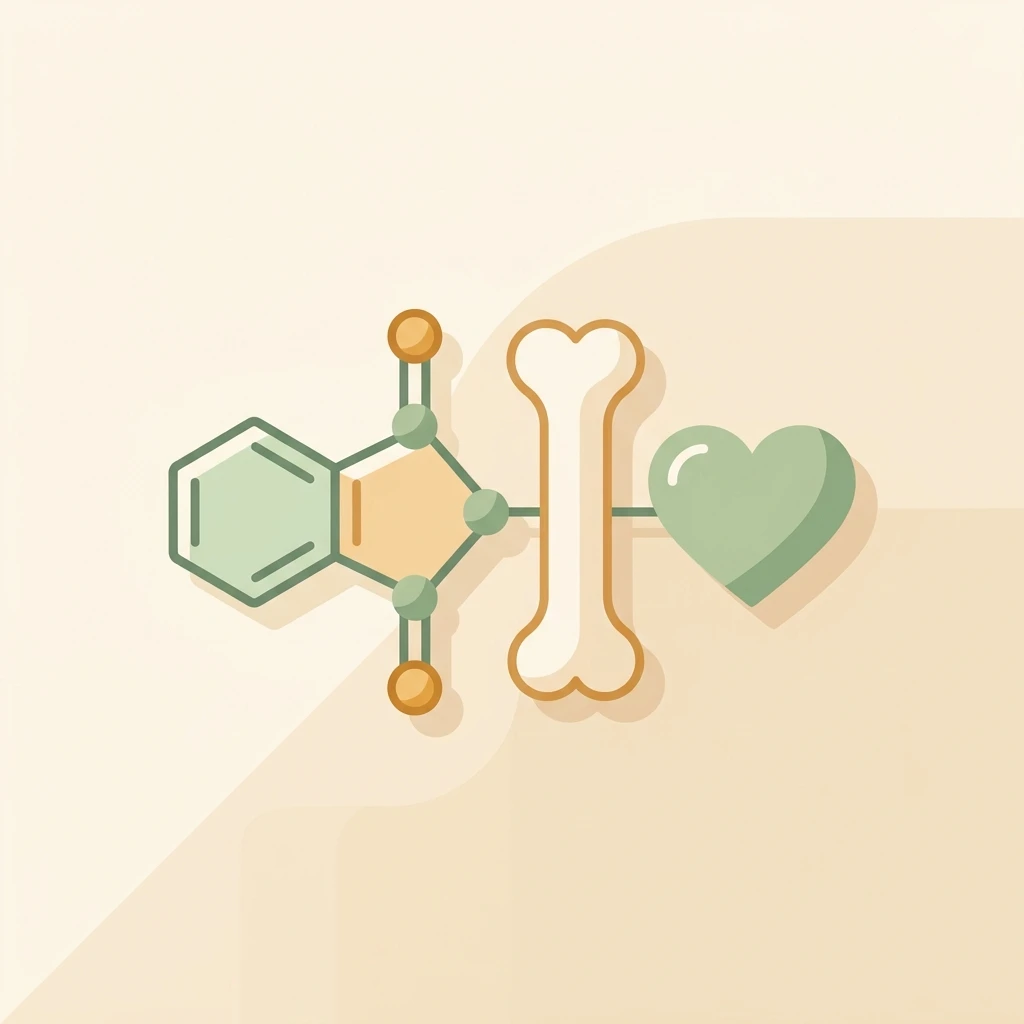
Vitamin K is not one molecule but a family of compounds sharing a naphthoquinone ring with different side chains.
- Vitamin K1 (phylloquinone) is the plant form, abundant in leafy greens (kale, spinach, broccoli). It’s absorbed poorly from plant matrix (bioavailability as low as 10%) and is preferentially routed to the liver, where it supports the synthesis of clotting factors II, VII, IX, and X.
- Vitamin K2 (menaquinone) is a bacterial/animal form with a longer isoprenoid side chain, denoted MK-n where n is the number of isoprenoid units. It’s absorbed more efficiently and distributes to extrahepatic tissue — bone, arterial walls, cartilage — where clotting is irrelevant but two other proteins matter enormously.
The Gla-Protein Mechanism: Why K2 Activates What D3 Builds
Vitamin K’s sole enzymatic role is as a cofactor for gamma-glutamyl carboxylase, an enzyme that converts specific glutamate (Glu) residues on certain proteins into gamma-carboxyglutamate (Gla) residues. This carboxylation reaction is what allows those proteins to bind calcium — an uncarboxylated protein is structurally present but functionally inert.
Two Gla-proteins matter for this guide:
- Osteocalcin, produced by osteoblasts, must be carboxylated to bind calcium hydroxyapatite crystals into bone matrix. Vitamin D increases osteocalcin production; vitamin K2 makes it functional.
- Matrix Gla Protein (MGP), produced by vascular smooth muscle cells, is the body’s primary inhibitor of arterial calcification. Carboxylated MGP actively blocks calcium deposition in blood vessel walls; the uncarboxylated form cannot.
[!TIP] This is the “lock and key” relationship supplement labels rarely explain: vitamin D3 raises the supply of osteocalcin and MGP, but without adequate vitamin K2, a meaningful fraction remains in the inactive, uncarboxylated state — unable to either build bone or protect arteries.
A large population cohort (the Rotterdam Study, n=4,807) found that participants in the highest tertile of dietary menaquinone (K2) intake had a 57% lower risk of coronary heart disease mortality and 26% lower all-cause mortality compared to the lowest tertile, with no comparable association for phylloquinone (K1) intake — evidence that the extrahepatic, MGP-activating role is specific to the K2 forms.
MK-4 vs. MK-7: Not the Same Supplement
The two menaquinone forms sold as supplements behave very differently in the body, and treating them as interchangeable is the most common formulation mistake.
| Property | MK-4 | MK-7 |
|---|---|---|
| Side chain length | Short (4 isoprenoid units) | Long (7 isoprenoid units) |
| Source | Synthetic, or converted from K1 in animal tissue | Fermented (natto, some synthetic) |
| Serum half-life | ~1-2 hours | ~72 hours |
| Typical studied dose | 15-45 mg/day (milligrams) | 90-180 mcg/day (micrograms) |
| Dosing frequency for steady state | Multiple times daily | Once daily |
| Human RCT evidence base | Extensive in Japan (osteoporosis drug approval) | Extensive in Europe (arterial stiffness, bone) |
The dose units aren’t a typo — MK-4’s clinical dose (milligrams) is roughly 200-500x larger than MK-7’s (micrograms), because MK-4 is cleared from circulation within hours and never accumulates, while MK-7’s long half-life lets it build up to a stable, elevated serum concentration with ordinary daily dosing.
A three-year randomized, double-blind, placebo-controlled trial in 244 healthy postmenopausal women found that 180mcg/day of MK-7 significantly improved arterial elasticity markers and reduced the age-related stiffening of large arteries compared to placebo — one of the longest-duration RCTs available for any vitamin K2 form.
Absorption: A Fat-Soluble Vitamin Like Any Other
Vitamin K2, like D, E, and A, requires dietary fat and bile acid emulsification to be absorbed via chylomicrons in the small intestine. Taking it on an empty stomach substantially reduces uptake.
[!TIP] Take vitamin K2 with the same meal as vitamin D3 — both need dietary fat for absorption, and pairing them reinforces the mechanism above: D3 raises the supply of osteocalcin and MGP, and K2 activates them, ideally at the same time each day for consistent carboxylation.
The One Interaction That Changes Everything: Vitamin K Antagonists
Warfarin (brand name Coumadin) and acenocoumarol are a class of anticoagulants called vitamin K antagonists (VKAs). They work by blocking the vitamin K epoxide reductase (VKOR) enzyme that recycles vitamin K after it’s used — without recycled vitamin K, the liver cannot carboxylate clotting factors II, VII, IX, and X, and blood clots more slowly.
Any dietary or supplemental vitamin K — K1 or K2 — provides fresh substrate that competes against this mechanism. A sudden increase in vitamin K intake can measurably lower a patient’s INR (International Normalized Ratio), reducing anticoagulant effectiveness and raising clot risk. This isn’t a theoretical concern — it’s the reason patients on warfarin are counseled to keep their vitamin K intake consistent day to day rather than avoiding it entirely.
[!WARNING] If you take warfarin or acenocoumarol, do not start, stop, or change the dose of any vitamin K2 supplement without your prescribing physician’s involvement and closer INR monitoring. This applies even to “small” doses — MK-7 at just 90mcg/day has been shown to measurably interfere with warfarin dose stabilization in clinical studies.
Critically, this interaction is specific to vitamin K antagonists. Direct oral anticoagulants (DOACs) — apixaban (Eliquis), rivaroxaban (Xarelto), dabigatran (Pradaxa), edoxaban (Savaysa) — work through entirely different mechanisms (direct factor Xa or thrombin inhibition) and do not interact with vitamin K intake. Patients on DOACs do not need to restrict or coordinate vitamin K2 supplementation for this reason.
Vitamin K2 and the Calcium Paradox
The calcium supplementation literature contains a genuinely uncomfortable finding: several large meta-analyses have linked isolated, high-dose calcium supplementation (without co-administered vitamin D or K2) to a modest increase in cardiovascular event risk — plausibly because calcium is being absorbed and mobilized without adequate carboxylated MGP to keep it out of arterial walls. Vitamin K2 is the mechanistic missing piece in that literature: it doesn’t change how much calcium is absorbed, but it changes where the body is biochemically capable of directing it.
Food Sources vs. Supplementation
Natto (fermented soybeans) is by a wide margin the richest dietary source of MK-7, containing several hundred micrograms per 100g serving — far more than any other common food. Hard, aged cheeses (particularly Gouda and Brie-style cheeses fermented with specific bacterial strains) and egg yolks contain smaller amounts of longer-chain menaquinones, while animal liver contains primarily MK-4 converted from dietary K1. For anyone unwilling to eat natto regularly, an MK-7 supplement is the more practical route to the doses studied in the arterial-stiffness and bone trials above.
References
- Schurgers LJ, Teunissen KJ, Hamulyák K, Knapen MH, Vik H, Vermeer C. Vitamin K-containing dietary supplements: comparison of synthetic and natural forms. Blood. 2007.
- Geleijnse JM, Vermeer C, Grobbee DE, et al. Dietary intake of menaquinone is associated with a reduced risk of coronary heart disease: the Rotterdam Study. Journal of Nutrition. 2004.
- Knapen MH, Braam LA, Drummen NE, Bekers O, Hoeks AP, Vermeer C. Menaquinone-7 supplementation improves arterial stiffness in healthy postmenopausal women. Thrombosis and Haemostasis. 2015.
- Booth SL. Vitamin K: food composition and dietary intake. Food & Nutrition Research. 2012.
- Holbrook AM, Pereira JA, Labiris R, et al. Systematic overview of warfarin and its drug and food interactions. Archives of Internal Medicine. 2005.
- Simes DC, Viegas CSB, Araújo N, Marreiros C. Vitamin K as a Powerful Micronutrient in Aging and Age-Related Diseases: Pros and Cons from Clinical Studies. International Journal of Molecular Sciences. 2019.
- National Institutes of Health, Office of Dietary Supplements. Vitamin K - Health Professional Fact Sheet. NIH Office of Dietary Supplements. 2021.
This article is for informational purposes only and does not constitute medical advice. Consult a qualified healthcare professional before changing your supplement or medication routine, especially if you take warfarin or any other vitamin K antagonist.
Common Questions
Should I take MK-4 or MK-7 vitamin K2?
MK-7 is generally the better default. Its longer half-life (~72 hours) produces stable serum levels with once-daily dosing, whereas MK-4 clears in 1-2 hours and requires multiple daily doses (typically 15-45mg) to replicate the same effect. Most human intervention trials showing bone and arterial benefits used MK-7 at 90-180mcg/day.
Do I need to take vitamin K2 with vitamin D3?
It's the single most important pairing. Vitamin D increases production of the proteins (osteocalcin, matrix Gla protein) that carry calcium — but those proteins are biologically inactive until vitamin K2 carboxylates them. Taking D3 without K2 can raise the amount of 'uncarboxylated' osteocalcin without directing where the calcium actually goes.
Can I take vitamin K2 if I'm on blood thinners?
Only under direct physician supervision if you take warfarin (Coumadin) or acenocoumarol — these drugs work by blocking vitamin K, so any supplemental K2 can reduce their effectiveness and increase clotting risk. This does NOT apply to direct oral anticoagulants (DOACs) like apixaban, rivaroxaban, or dabigatran, which don't use the vitamin K pathway.
Is there an upper limit or toxicity risk with vitamin K2?
No tolerable upper intake level has been established for any form of vitamin K — human and animal studies have found no toxicity even at very high doses in people not on vitamin K antagonist medication. The real risk isn't overdose; it's the drug interaction above.